












“`html
Cryptocurrencies növekedés az évek során
Understanding the Digital Currency Revolution
Cryptocurrencies are digital assets designed to work as a medium of exchange using cryptography to secure transactions and control the creation of additional currency units. As a subset of alternative currencies, or specifically digital currencies, they represent one of the most significant financial innovations of our time. Unlike traditional fiat currencies issued by central banks, cryptocurrencies operate on decentralized networks, giving users greater control over their funds and transactions.
Bitcoin fundamentally changed the landscape of digital money when it was introduced to the world in 2009. Since then, it has been followed by hundreds of other cryptocurrency types. Today, Bitcoin and over 800 altcoins have reached a combined market valuation exceeding hundreds of billions of dollars. Understanding how this emerging digital assets landscape began and where we stand today provides valuable insight into the future of finance. The rapid expansion of the cryptocurrency market reflects growing global interest in decentralized financial systems and blockchain technology applications.
The Pre-Bitcoin Era and Satoshi’s Gift
Early Visions of Digital Currency
Since the beginning of the Internet’s early days, the concept of digital money has intrigued humanity. When the world wide web became popularized during the late eighties and throughout the nineties, online privacy activists called cypherpunks began creating and envisioning digital currencies. Cryptographers like David Chaum and many other well-known experts helped pave the way for transformative technology like Bitcoin. These pioneers recognized that the internet could enable peer-to-peer transactions without intermediaries, laying the philosophical foundation for what would eventually become cryptocurrency. Their work in cryptography and digital signatures established the mathematical principles that would become essential to blockchain technology.
Predecessors to Bitcoin
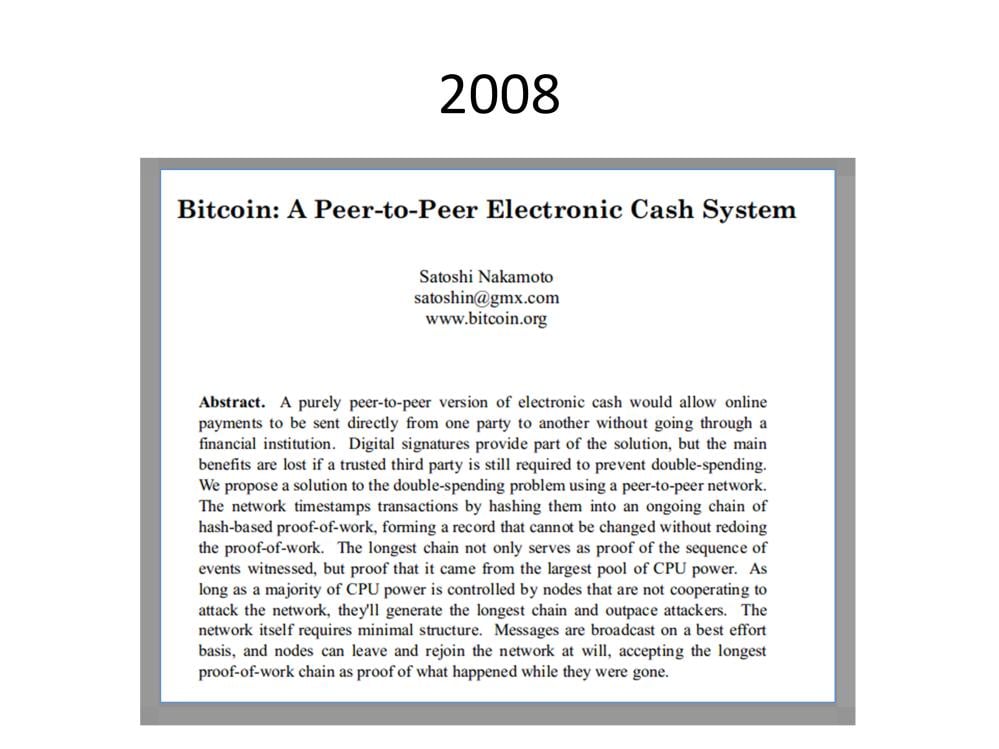
One of the first digital currencies was Digicash, created by David Chaum in the 1980s. This innovative system utilized blind signatures to provide user anonymity and was later sold and used for bank-to-bank settlements only. Throughout the nineties and early two thousands, many other efforts emerged to create the perfect Internet currency. These included Hashcash, developed by Adam Back as a proof-of-work system; e-gold, which allowed users to hold and trade gold online; and Bitgold, designed by Nick Szabo as a precursor to modern cryptocurrency concepts. However, these ideas never really caught on with mainstream audiences until an anonymous developer named Satoshi Nakamoto revealed his groundbreaking white paper called “Bitcoin” in 2008.
The following year in January, the Bitcoin network was officially born with the genesis block. Notably, this occurred while the central banking system was quantitatively easing the world away from economic failure during the global financial crisis of 2008-2009. This timing proved significant, as many saw Bitcoin as a response to traditional financial instability and government monetary policies. The emergence of Bitcoin demonstrated that decentralized digital currency could function without relying on banks or governmental institutions. The timing of Bitcoin’s launch amid financial turmoil created a compelling narrative around cryptocurrency as an alternative financial system.
A Bitcoin több száz klónt hozott létre, amelyek különböző funkciókat kínálnak
The Emergence of Alternative Cryptocurrencies
Following Bitcoin’s success as the first cryptographic currency with a blockchain, the technology demonstrated it had superior potential compared to predecessors conceived before it. The innovation and success of Bitcoin inspired the creation of numerous other cryptocurrencies that appeared shortly after its launch. Some of the earliest blockchain-based digital assets include Litecoin, created by Charlie Lee in 2011; Namecoin, which combined cryptocurrency with a decentralized domain name system; Feathercoin, designed for faster transaction times; and Peercoin, which pioneered hybrid consensus models.
Each of these early altcoins offered distinct advantages and innovations. Some introduced different algorithms, new features, or varying amounts of tokens. For instance, Tenebrix was the first scrypt coin, which led to the vast proliferation of other coins that were supposed to be “ASIC proof,” meaning resistant to specialized mining hardware. However, this claim ultimately proved to be untrue as ASIC miners were eventually developed for scrypt as well. Litecoin followed the ideas pioneered by Tenebrix with its scrypt-based algorithm and has remained a top ten contending cryptocurrency by valuation since its inception in 2011. The success of Litecoin demonstrated that Bitcoin clones with technical modifications could achieve significant market acceptance.

Innovation in Consensus Mechanisms and Protocols
The cryptocurrency landscape continued to evolve with new consensus mechanisms and protocols that addressed limitations in Bitcoin’s original design. Peercoin introduced proof of stake (PoS) consensus in 2012, although it also retained Proof-of-Work for important system functions. This hybrid approach represented a significant innovation in blockchain technology, offering reduced energy consumption compared to pure proof-of-work systems. Primecoin pioneered a scientific computing proof-of-work system, allowing mining to contribute to meaningful computational research by searching for prime number chains.
Bytecoin introduced the Cryptonote protocol for enhanced privacy features, addressing growing concerns about transaction transparency in Bitcoin. These innovations demonstrated that the cryptocurrency space was rapidly evolving beyond Bitcoin’s original design. Developers and researchers continuously explored new consensus mechanisms, cryptographic techniques, and protocol improvements. The diversity of approaches reflected the experimental nature of early cryptocurrency development, where different teams tested various solutions to fundamental problems like energy efficiency, scalability, and privacy.
Market Growth and Mainstream Adoption
As more altcoins entered the market, the total cryptocurrency market capitalization experienced exponential growth. By 2013, Bitcoin’s price had skyrocketed, attracting mainstream media attention and spurring new investors to explore the cryptocurrency space. This bull market encouraged entrepreneurs and developers to launch their own digital currencies, leading to hundreds of new projects. The proliferation of ICOs (Initial Coin Offerings) in later years further accelerated market growth and brought blockchain technology into wider public consciousness.
The success of cryptocurrencies like Litecoin and Ripple demonstrated that markets could support multiple digital currencies simultaneously. Each offered different value propositions, from faster transaction speeds to improved privacy features. This competitive landscape drove continuous innovation and attracted venture capital investment into blockchain startups. The growth trajectory from 2009 to the present day shows how cryptocurrency evolved from a niche concept understood by cryptography experts into a global financial phenomenon touching millions of users worldwide.
The Future of Cryptocurrencies
Looking ahead, the cryptocurrency market continues to mature with improved regulatory frameworks, institutional adoption, and technological advancements. Layer 2 scaling solutions, interoperability protocols, and advances in consensus mechanisms promise to address current limitations in blockchain technology. Smart contract platforms like Ethereum have opened entirely new categories of blockchain applications beyond simple currency transfers. The ongoing development of central bank digital currencies (CBDCs) and integration with traditional finance suggests that cryptocurrency will play an increasingly important role in the global financial system.
Gyakran ismételt kérdések
Mi az a kriptopénz?
Cryptocurrency is a digital or virtual currency that uses cryptography for security. Unlike traditional currencies issued by central banks, cryptocurrencies operate on decentralized networks called blockchains, which maintain transaction records and ensure the integrity of the network without requiring a central authority.
Who created Bitcoin?
Bitcoin was created by an anonymous individual or group using the pseudonym Satoshi Nakamoto. The Bitcoin white paper was published on October 31, 2008, and the network officially launched on January 3, 2009, with the mining of the genesis block.
What is the difference between Bitcoin and altcoins?
Bitcoin is the first and most well-known cryptocurrency, while altcoins refers to all other cryptocurrencies created after Bitcoin. Altcoins often introduce different features, consensus mechanisms, or use cases compared to Bitcoin, such as faster transaction times or enhanced privacy features.
What are consensus mechanisms?
Consensus mechanisms are protocols that allow distributed networks to agree on the validity of transactions without a central authority. Proof of Work and Proof of Stake are two major consensus mechanisms used in blockchain technology. Proof of Work requires miners to solve complex mathematical problems, while Proof of Stake selects validators based on their cryptocurrency holdings.
How has the cryptocurrency market grown?
The cryptocurrency market has experienced exponential growth since Bitcoin’s launch in 2009. From a market capitalization of mere thousands of dollars, the total crypto market has grown to hundreds of billions of dollars, attracting institutional investors, venture capitalists, and millions of retail users worldwide.
What are altcoins and why were they created?
Altcoins are alternative cryptocurrencies created after Bitcoin’s success. They were developed to address perceived limitations in Bitcoin or to introduce new features and innovations. Examples include Litecoin for faster transactions, Ethereum for smart contracts, and various privacy-focused coins offering enhanced anonymity.
What was the significance of Bitcoin’s timing?
Bitcoin launched during the 2008-2009 global financial crisis, when traditional financial institutions faced severe challenges. This timing positioned Bitcoin as an alternative to traditional finance and government monetary policies, contributing significantly to its adoption narrative and appeal to users seeking financial independence.
“`